
A signature is an important part of many documents, including business agreements, official letters, financial records, and other paperwork. However, signing every document by hand can take time, especially when a person needs to approve a large number of documents regularly.
Therefore, people often use alternatives such as signature stamps and signature facsimiles to reproduce a handwritten signature. Although these terms are sometimes used interchangeably, they can refer to different methods of reproducing a signature.
In this article, we are going to discuss the difference between a signature stamp and a signature facsimile and explain how each one works.
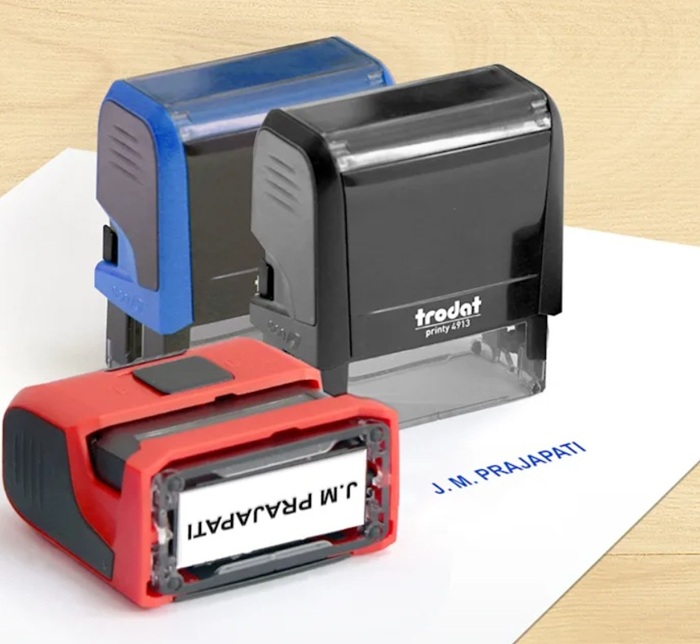
What Is the Difference Between a Signature Stamp and a Signature Facsimile?
What is a Signature Stamp?
A signature stamp is a physical stamping device that contains a person’s signature. It allows the user to reproduce that signature on paper by pressing the stamp onto the document.
The signature is usually created from a sample of the person’s handwritten signature. Once the stamp is manufactured, it can be used repeatedly without requiring the person to sign each document by hand.
For example, a business owner who regularly signs invoices, internal forms, and routine letters may use a Signature Stamp to save time. Instead of manually signing every document, an authorized person can apply the stamp whenever required.
Signature stamps are available in different types, including traditional rubber stamps and self inking stamps. The choice depends on how frequently the stamp will be used and the user’s requirements.
What is a Signature Facsimile?
A signature facsimile is a reproduction of a person’s handwritten signature. It can be produced using different methods, including printing, copying, engraving, or digital reproduction.
Unlike a physical signature stamp, the term signature facsimile refers to the reproduced signature itself rather than one specific stamping device.
For instance, a company may print a manager’s signature on a large number of letters before distributing them. These printed signatures are examples of signature facsimiles.
A signature facsimile can also appear in an electronic document or digital image. Therefore, it is a broader term that covers several ways of reproducing a signature.
Key Differences Between a Signature Stamp and a Signature Facsimile
The main difference between these two terms is the method used to reproduce the signature.
A signature stamp is a physical tool that transfers a signature onto paper. A signature facsimile is the reproduced version of a signature, regardless of whether it is applied using a stamp, printed on paper, or reproduced digitally.
Here are the major differences to consider.
1. Method of reproduction
A signature stamp uses a physical stamping mechanism to apply ink to a document. A signature facsimile may be printed, copied, stamped, or reproduced through digital means.
2. Physical form
A signature stamp is a tangible device that can be held and used by hand. A signature facsimile does not have to be a physical device. It can exist as a printed signature or a digital image.
3. Repeated use
A signature stamp can be used repeatedly on different documents. A signature facsimile can also be reproduced many times, depending on the method used to create and distribute it.
4. Practical applications
Signature stamps are useful for routine paperwork that requires frequent signing. Signature facsimiles are often used in printed correspondence, reproduced documents, and certain electronic workflows.
Conclusion
A signature stamp and a signature facsimile both help reproduce a handwritten signature, but they are not exactly the same thing. A signature stamp is a physical device used to apply a signature to paper, while a signature facsimile is a reproduced signature that can be created through several methods.
If you regularly sign routine business documents, a Signature Stamp may be a practical option for saving time. If you need to reproduce a signature in printed materials or electronic documents, a signature facsimile may be more suitable.
Before using either method, check whether the document permits a reproduced signature and make sure the signature is used only with proper authorization.
